






In 2026, building the right software team is a major challenge for many businesses. Technology moves fast, and competition is high. Companies need reliable development support to grow and stay relevant.
Hiring skilled developers is not easy. Recruitment takes time. Costs are high. Managing an internal team requires long-term commitment and constant effort. Because of this, many businesses look for better and more flexible options.
A dedicated development team offers that flexibility. It allows companies to work with experienced professionals who focus only on their project. This model helps businesses move faster without the burden of full internal hiring.
This guide explains how to hire a dedicated development team step by step. You will learn the benefits, the hiring process, the costs involved, and best practices to build a team that delivers real results.
What is a Dedicated Development Team?
A dedicated development team is a group of skilled professionals who are assigned only to your project. The team is built specifically for your needs and stays focused on your product for the long term.
This model is different from simply hiring individual developers. A dedicated team works as a complete unit with clear roles and shared responsibility. The team follows a structured workflow and aligns closely with your business goals rather than handling short-term tasks.
Unlike short-term contractors, a dedicated development team is designed for ongoing collaboration. The team builds deep knowledge of your product and processes over time. This leads to better decisions, smoother development, and consistent results.
A dedicated development team usually includes software developers, project managers, QA specialists, and supporting roles such as UI/UX designers and DevOps engineers. Each role contributes to building, testing, and maintaining your software in a stable and scalable way.
Who Is in a Dedicated Development Team?
A right dedicated development team is made up of professionals who work together to build and maintain your software product. The exact team composition depends on your project scope, but most dedicated teams include the following roles.
Software Developer
Software developers are the core of a dedicated development team. They are responsible for building the product and handling ongoing development work. Because they reserved for your project, they develop a deep understanding of your business goals and technical requirements.
Primary Responsibilities
- Write and improve code
- Develop new features
- Fix bugs and issues
- Collaborate with other team members
- Work on frontend, backend, or full-stack development based on the tech stack
QA Engineers / Testers
QA engineers are responsible for maintaining software quality. In a dedicated development team, they ensure the product works as expected and meets defined quality standards before release.
Primary Responsibilities
- Test features and functionality
- Identify and report bugs
- Verify fixes and updates
- Check system performance across scenarios
- Work closely with developers to ensure stability
Business Analyst (BA)
A business analyst connects business needs with the technical team. In a dedicated development team, the BA ensures requirements are clearly defined and aligned with business goals.
Primary Responsibilities
- Gather and analyze project requirements
- Document workflows and specifications
- Clarify expectations for developers and QA engineers
- Communicate with stakeholders
- Ensure the product solves the right business problems
UI/UX Designers
UI/UX designers focus on how the product looks and feels. They ensure the interface is user-friendly, visually clear, and aligned with user expectations.
Primary Responsibilities
- Design layouts and user interfaces
- Create user flows and wireframes
- Improve usability and user experience
- Collaborate with developers and business analysts
- Align design with business and user needs
DevOps Engineer
A DevOps engineer supports development by managing infrastructure and deployment processes. They help keep the software stable, secure, and scalable as it grows.
Primary Responsibilities
- Manage deployment pipelines
- Monitor system performance
- Handle cloud environments
- Improve reliability and scalability
- Work with developers to streamline releases
How Dedicated Team Engagement Model is Differ from Other Models
Understanding how a dedicated development team compares to other engagement models helps you choose the right approach for your project.
Dedicated Team vs. Fixed Price Model
The fixed price model works best when project requirements are clear and unlikely to change. The scope and budget are defined upfront, which makes planning simple for short-term projects.
However, this model lacks flexibility. Any change in requirements can increase costs or delay delivery. Because of this, fixed price projects are usually suitable for projects under six months with very stable requirements.
A dedicated development team is more flexible. The team can adapt to changes and continue working as the project evolves, making it better for long-term development.
Dedicated Team vs. Time & Materials (T&M)
The time and materials model allows changes in scope and requirements. You pay for the time spent and resources used, which offers flexibility during development.
The downside is that developers may not be fully dedicated to your project. They often work on multiple projects at the same time, which can affect focus and continuity.
In contrast, a dedicated development team works exclusively on your project. This provides stability, consistent progress, and stronger ownership throughout the development process.
Dedicated Team vs. In-House Team
An in-house team gives you full control over development, but it also comes with high costs. Recruitment, salaries, benefits, office space, and infrastructure require significant investment and time.
A dedicated team provides access to a global talent pool without these administrative burdens. The vendor handles hiring, payroll, retention, and infrastructure, while you stay focused on product direction. In many cases, dedicated teams are 40–60% more cost-effective than building an in-house team.
Dedicated Team vs. Traditional Outsourcing
Traditional outsourcing is usually used for one-time or short-term projects. Client involvement is limited, and the team typically moves on once the work is delivered.
A dedicated development team is built for long-term collaboration. The team stays involved, gains deep knowledge of your product, and works closely with you. This shared responsibility leads to better alignment, stronger control, and more consistent results over time.
Dedicated Development Team vs Other Engagement Models
| Criteria | Dedicated Development Team | Fixed Price Model | Time & Materials (T&M) | In-House Team |
|---|---|---|---|---|
| Project Scope | Flexible and evolving | Clearly defined and fixed | Flexible | Flexible |
| Project Duration | Long-term | Short-term | Mid-term | Long-term |
| Team Focus | Works exclusively on your project | Assigned only until delivery | Often shared across projects | Fully dedicated |
| Flexibility | High | Low | Medium to high | High |
| Cost Structure | Monthly predictable cost | Fixed upfront cost | Pay per hour / resource | High ongoing expenses |
| Cost Efficiency | High | Medium | Medium | Low |
| Change Management | Easy to adapt | Costly and slow | Easy | Easy but expensive |
| Team Continuity | Stable long-term team | Ends after project | Not guaranteed | Stable |
| Client Control | High | Limited | Medium | Full |
| Administrative Effort | Vendor handles HR & operations | Vendor handles | Vendor handles | Client handles everything |
| Best For | Long-term, complex, evolving projects | Short projects under 6 months | Projects with some scope changes | Companies building internal capability |
| Main Limitation | Requires ongoing commitment | No flexibility | Lack of exclusive focus | High cost and slow hiring |
When to Hire a Dedicated Development Team
Hiring a dedicated development team makes the most sense when your project needs long-term focus, flexibility, and consistent execution. This model is designed for situations where short-term outsourcing or quick in house hiring cannot meet business demands.
Below are the most common and practical scenarios where a dedicated team model works best.
Startups and Early-Stage Companies
Startups often lack the time and resources required for internal hiring. Building an internal team can slow down product launches and increase operational costs.
A dedicated development team allows startups to outsource development while still maintaining control over the development process. It provides access to a global talent pool and lets the team work exclusively on the product without long-term employment commitments.
Long-Term Development Projects
For projects that run longer than 12 months, requirements often change and grow over time. In such cases, team continuity and product knowledge are critical.
A dedicated software development team stays involved throughout the project lifecycle. This ensures stable workflows, better understanding of project requirements, and consistent progress across development cycles.
Scaling Existing Products
As products grow, internal teams may struggle with increasing workloads. Adding features, improving performance, and handling user growth can stretch an in-house team beyond its capacity.
A dedicated development team helps fill skill gaps and increase team size without disrupting internal operations. This allows businesses to scale faster while maintaining quality and delivery speed.
Projects with Unclear or Evolving Requirements
Some projects begin with limited clarity and require ongoing discovery. Market feedback, user testing, and business changes can shift priorities quickly.
The reliable team supports flexibility. It works closely with stakeholders, adapts to changes, and adjusts the project scope without restarting contracts or restructuring teams.
Multiple Ongoing Projects
Managing several projects at once requires focused execution and clear team structure. Sharing developers across initiatives often leads to delays and reduced accountability.
Dedicated teams allow businesses to assign focused teams to individual projects. Each team works independently, follows a defined workflow, and stays aligned with specific business needs.
Key Benefits of a Dedicated Development Team
Choosing the right team model can directly impact cost, speed, and long-term results. Below are the main benefits of a dedicated team engagement model, explained using a broader range of terms to reflect real business value.
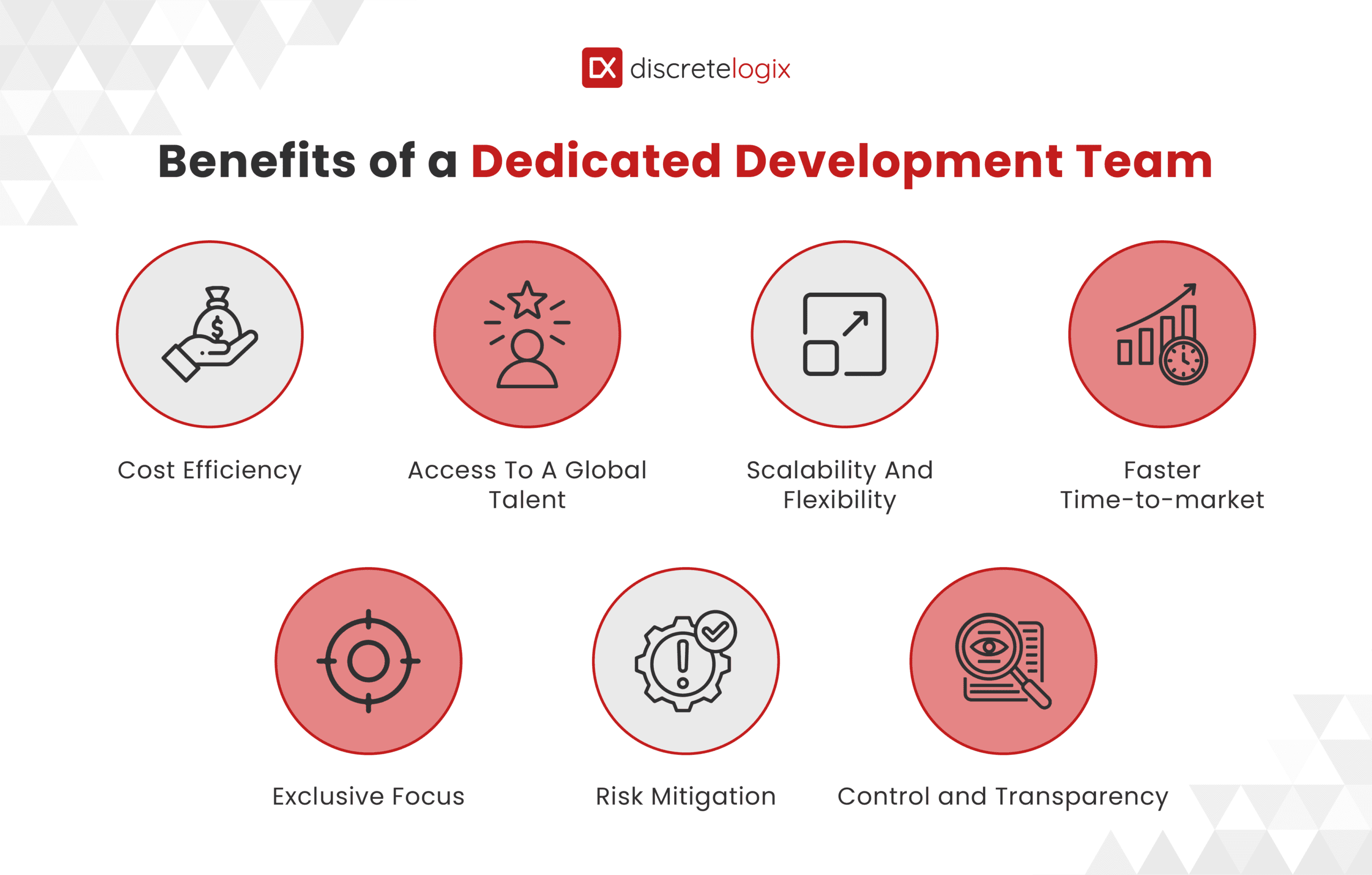
Cost Efficiency
This engagement model offers predictable development costs instead of fluctuating expenses common with in-house hiring. You pay a consistent monthly rate, which makes budgeting easier for ongoing development projects.
There are no added costs for recruitment, HR, office space, or infrastructure. The outsourcing company handles payroll, retention, and administration. By working with an external dedicated team from cost-effective regions, businesses often reduce overall development costs by 40–60% compared to in-house development.
Access to a Global Talent Pool
Local hiring limits access to skilled professionals, especially for modern and niche technologies. A remote team removes geographic barriers and gives you access to a broader talent pool.
This model allows you to hire skilled software engineers, QA engineers, and specialists with proven experience in complex projects. These professionals are usually pre-vetted, reducing hiring risk and ensuring the team has the right skills from day one.
Scalability and Flexibility
The dedicated model makes it easy to adjust team size based on project demands. You can add or remove team members as requirements evolve, without restarting the hiring process.
Whether your software solution grows or priorities shift, this model supports quick scaling. Teams are typically assembled within a few weeks, allowing businesses to adapt to market changes without delays.
Faster Time-to-Market
Traditional in-house hiring slows down product development due to long recruitment cycles. With an outsourced team, work can begin much sooner.
An experienced development team follows established workflows and tools, which shortens development cycles. In some cases, time zone compatibility also helps maintain steady progress across different working hours.
Exclusive Focus and Deep Product Knowledge
Unlike shared resources, this model ensures the team works exclusively on your project. The team focuses solely on your software product and becomes deeply familiar with your business goals and technical requirements.
This continuity prevents knowledge loss, improves collaboration, and helps build a development team that delivers consistent quality over time.
Risk Mitigation
Operational and administrative risks are largely handled by the vendor. This includes HR management, team replacement, and infrastructure support.
Clear workflows, defined quality standards, and transparent communication reduce risks during ongoing development. Many providers also offer trial periods, helping businesses validate the team before long-term commitment.
Control and Transparency
This model provides strong control over the development process. You remain involved in planning, prioritization, and key decisions while the external team handles execution.
Direct communication with team members, regular updates, and shared project management tools ensure transparency. The team works as an extension of your company, giving you visibility and control without internal overhead.
How Much Does Hiring a Dedicated Development Team Cost?
Cost is one of the main reasons businesses choose this model. Many companies today continue to invest in third-party development because it helps control expenses while keeping development moving forward.
Instead of spending money on internal hiring and long-term overhead, companies pay directly for development work. This makes costs easier to understand and manage.
How the pricing usually works
The pricing approach for a dedicated team is straightforward.
Each person on the team has an hourly rate based on their role and experience. This may include developers, QA engineers, designers, project managers, or business analysts. You are billed only for the hours the team actually spends working on your project.
There are no hidden operational expenses. You don’t pay for office rent, equipment, software tools, employee taxes, onboarding, or HR management. These costs are covered by the service provider.
Because of this, the budget is used entirely for product development rather than internal infrastructure. For startups and companies based in high-cost regions, this alone can result in noticeable savings.
What affects the final cost
Although the pricing model is simple, the total cost depends on several factors.
The structure of the team plays a big role. A team made up only of engineers costs less than a full cross-functional team that includes testing, design, and management roles. The experience level of team members also matters, as senior specialists typically charge higher rates.
Location is another key factor. Rates vary depending on whether the development partner is based in Europe, Latin America, Asia, or North America. Project duration, workload, and the need for specialized skills such as DevOps, AI, or security can also influence the final cost.
Typical hourly rate ranges
Hourly rates differ by region and role. The ranges shared below are based on general market trends and should be viewed as estimates. Actual pricing depends on the developer’s experience level, technology stack, and project requirements.
Average Hourly Cost by Role and Region
| Role | North America | Europe | Latin America | Asia |
|---|---|---|---|---|
| Software Developer (Frontend / Backend) | $80 – $150 | $40 – $100 | $40 – $75 | $25 – $55 |
| Full-Stack Developer | $90 – $170 | $45 – $110 | $45 – $80 | $30 – $60 |
| Mobile App Developer | $90 – $160 | $45 – $115 | $45 – $80 | $30 – $65 |
| QA Engineer / Tester | $50 – $110 | $30 – $70 | $30 – $55 | $20 – $45 |
| UI/UX Designer | $60 – $120 | $35 – $85 | $35 – $60 | $25 – $50 |
| Project Manager / Product Owner | $70 – $150 | $40 – $90 | $45 – $75 | $30 – $60 |
| Business Analyst | $60 – $130 | $35 – $85 | $35 – $65 | $25 – $50 |
| DevOps Engineer | $90 – $180 | $50 – $110 | $45 – $80 | $35 – $70 |
| Software Architect | $100 – $200 | $60 – $130 | $60 – $100 | $45 – $90 |
Why It’s Cheaper Than Hiring In-House
Building a full in-house team is slow and expensive. It involves recruiting, screening, onboarding, trial periods, employee benefits, equipment, and ongoing administrative work. All of this adds cost before real development even begins.
A dedicated team removes most of these expenses. You work with professionals who are already hired, trained, and ready to contribute. This allows companies to start faster and spend money on development instead of internal operations.
With this model, you get:
- Faster hiring, often in days or weeks instead of months
- Access to pre-vetted specialists with proven experience
- No recruitment or onboarding costs
- No long-term employment commitments
- The ability to scale the team up or down as needed
What Affects the Final Cost
Even though the pricing model is simple, the final cost depends on a few practical factors.
The team composition plays a major role. A team made up only of engineers costs less than a full cross-functional team that includes QA, design, and management roles.
Seniority levels also matter, as senior specialists usually charge higher rates.
The location of the development partner affects pricing as well. Teams based in Europe, Latin America, Asia, or North America have different rate ranges.
In addition, project duration and workload impact cost, especially for long-term or ongoing development.
Finally, projects that require specialized expertise such as AI, DevOps, or cybersecurity may increase the overall cost.
Why Discretelogix Is a Good Choice for Hiring Dedicated Development Team
Discretelogix works with businesses that need reliable development support for the long term. Instead of offering temporary resources, we focus on building teams that stay involved and grow with the product.
Our teams are set up to work as an extension of your internal team. They don’t jump between projects or disappear after delivery. This helps maintain continuity, product understanding, and steady progress.
We believe a dedicated team should do more than just write code. Our developers and project leads actively participate in planning, problem-solving, and improving the development approach as the product evolves.
This approach works especially well for companies that are scaling, launching new products, or managing ongoing development where consistency matters more than short-term speed.
How We Set Up a Dedicated Development Team at Discretelogix
Our setup process is designed to be clear, practical, and fast. We avoid unnecessary steps and focus on what actually helps projects move forward.
Understanding Your Needs First
We start by understanding your product, business needs, and challenges. This includes discussing what you want to build, expected timelines, and the level of support you need.
If your requirements are clear, we move forward quickly. If they are still evolving, we help bring clarity before assembling the team.
Building the Right Team
Based on your needs, we select developers and specialists who match your technical requirements and working style. Selection is based on experience, communication skills, and long-term availability.
The goal is to create a stable team that can stay with your product, not a temporary setup.
Aligning on Expectations
Before development starts, we align on priorities, responsibilities, and ways of working. This helps avoid confusion later and ensures both sides know what success looks like.
Starting and Scaling
Once everything is aligned, the team starts working on your project. As your needs change, the team can be scaled up or adjusted without disrupting progress.
Ongoing Collaboration
Throughout the engagement, you stay closely connected with the team. Communication stays direct, progress is visible, and decisions are made together.
Conclusion
Hiring a dedicated development team is a practical choice for businesses that need long-term focus, flexibility, and reliable delivery. This model helps you avoid the challenges of in-house hiring while giving you access to skilled professionals who work just on your product.
When done right, a dedicated team becomes an extension of your company. It brings continuity, better understanding of your business goals, and the ability to adapt as project requirements change. From cost control to faster delivery and scalable team structures, the benefits go beyond short-term development.
If you’re looking for a partner that values transparency, stability, and long-term collaboration, Discretelogix offers a structured and flexible approach to building dedicated teams that grow with your product.
The key is choosing the right team, the right engagement model, and a partner that aligns with your vision. With the right setup, a dedicated development team can support sustainable growth and deliver real business value over time.
Frequently Asked Questions
Can a dedicated software development team work remotely?
Yes, a dedicated software development team can work fully as a remote team. This is one of the biggest advantages of this model. Remote teams use project management tools, shared workflows, and regular communication to stay aligned.
Because the team works exclusively on your project, location does not affect focus or productivity. Many businesses use remote teams to access global talent while maintaining transparency and control over the development process.
How much does it cost to hire a development team?
The cost to hire a dedicated software development team depends on several factors, including team size, team composition, project demands, and geographic location. Development costs are usually lower than in house development because there are no recruitment, HR, or infrastructure expenses.
Most companies prefer this model because it offers predictable monthly spending and better control compared to in-house hiring or short-term outsourcing.
How to hire a team of dedicated developers?
To hire dedicated development team, start by defining your project requirements, business goals, and expected outcomes. Next, choose a team model that fits your needs and budget.
You should evaluate potential providers based on technical expertise, communication, and ability to work as an extension of your company. Interviewing developers, understanding the team approach, and agreeing on workflows are key steps in hiring the right team.
How to find a development team?
You can find a development team through a trusted outsourcing company, referrals, or companies that offer dedicated development team services. Look for teams with experience in similar development projects and a proven track record.
The right team should have the right skills, clear communication practices, and the ability to align with your internal team and product development goals.
What is the difference between a dedicated team and outsourcing?
Traditional outsourcing usually focuses on one-time or short-term delivery with limited involvement from the client. In contrast, a dedicated team engagement model is built for long-term collaboration.
A dedicated team works solely on your project, shares responsibility, and develops deep product knowledge. This model offers more control over the development process, better continuity, and stronger alignment with business goals than standard outsourcing.
When should you consider a dedicated development team model?
You should consider the dedicated development team model when you have ongoing development, complex projects, or changing requirements. It is especially useful when your internal team has skill gaps or limited capacity.
This model works best for long-term product development, scaling software solutions, and situations where you need a committed team that ensures consistent progress and reliable delivery.


