






Hiring software developers has become one of the biggest bottlenecks for growing companies. Even organizations with strong brands and large budgets struggle to find the right talent fast enough. According to Korn Ferry, the global shortage of skilled technology professionals is expected to reach 85 million by 2030, potentially causing $8.5 trillion in lost annual revenue worldwide. This is no longer a future concern — it is already affecting how products are built and scaled today.
Because of these challenges, traditional hiring alone is no longer practical for many businesses. Long recruitment cycles, rising salaries, and limited access to specialized skills push companies to explore more flexible team models. This raises an important question: why are Fortune 500 companies increasingly choosing team extension over traditional hiring?
A software team extension provides a practical answer. Instead of outsourcing entire projects or expanding permanent headcount, companies extend their existing development team with skilled external developers who work as part of the same team.
In this article, we’ll explain what software team extension model is, how it compares to other engagement models, its benefits and costs, and the practical steps needed to build and manage an extended software team successfully.
What Is Software Team Extension?
This approach allows companies to strengthen their existing development setup by adding external developers who work directly inside the team. These professionals are not treated as vendors or freelancers working in isolation. They use the same tools, follow the same workflows, and collaborate daily with internal team members. The company keeps full ownership of the product, technical decisions, and delivery priorities while gaining additional capacity or missing skills.
In simple terms, it’s about extending what you already have—without rebuilding your team or handing work off to an outside agency.
How It Works in Real Teams
External developers are selected and onboarded to work alongside the internal team. They are given access to the codebase, documentation, and communication channels, just like in-house developers. Once onboarded, they contribute to real development tasks and participate in regular team activities such as standups, sprint planning, reviews, and retrospectives.
Because communication happens directly within the same team, collaboration stays smooth and decision-making remains fast. The team can also be adjusted over time, depending on workload and priorities, without disrupting ongoing development.
Typical Team Structure
Most setups follow a simple structure that blends internal and extended resources:
- Internal leadership manages product direction and technical decisions
- Extended developers focus on development and implementation work
- Shared tools and workflows keep everyone aligned
- Clear reporting lines ensure accountability
This structure helps avoid silos and keeps everyone working toward the same goals.
Advantages and Limitations
Like any delivery model, this approach comes with both benefits and trade-offs.
Key advantages include:
- Faster access to experienced developers
- Flexible scaling without permanent hiring
- Lower long-term overhead
- Full control over quality and timelines
Possible limitations include:
- Requires active involvement from internal leadership
- Onboarding still takes time
- Communication needs to be managed carefully, especially across time zones
Who This Model Is Best Suited For
This approach works best for companies that already have an internal development team and clear ownership of their product. It is especially useful for startups, SaaS companies, and growing businesses that need to scale quickly or fill specific skill gaps without expanding permanent headcount.
It is less suitable for organizations looking for fully hands-off delivery, as success depends on close collaboration and internal involvement.
Team Extension vs Other Engagement Models
Companies exploring software team extension services often compare them with other engagement options such as dedicated teams, project outsourcing, staff augmentation, and in-house hiring. While these models are sometimes grouped together, they differ significantly in how teams collaborate, who owns delivery, and how flexible the setup is.
A development team extension is designed to expand an existing software development team without transferring responsibility outside the organization. The company continues to guide priorities, technical direction, and delivery standards, while additional developers contribute directly to ongoing work. This extended team model supports long-term collaboration and evolving requirements.
Other engagement models serve different needs. Dedicated development teams usually operate with shared responsibility. Project outsourcing shifts most delivery ownership to a vendor. Staff augmentation is commonly short-term and task-focused. In-house hiring emphasizes permanence but offers limited flexibility and slower scaling.
The table below outlines how software team extension compares with other common engagement models.
Engagement Model Comparison
| Factor | Software Team Extension | Dedicated Development Team | Project Outsourcing | Staff Augmentation | In-House Development Team |
|---|---|---|---|---|---|
| Control Over Development | High | Medium | Low | High | Highest |
| Level of Integration | Full | Partial | Minimal | Full | Full |
| Delivery Ownership | Internal team | Shared | Vendor | Internal team | Internal team |
| Scalability | High | Medium | Low | High | Low |
| Time to Start | 2 to 4 weeks | 4 to 6 weeks | 2 to 3 weeks | 1 to 2 weeks | 3 to 6 months |
| Cost Flexibility | High | Medium | Low | High | Low |
| Knowledge Retention | High | Medium | Low | Medium | Highest |
| Best Fit | Scaling existing teams | Long-term delivery | Fixed scope work | Short-term needs | Stable teams |
Benefits of Development Team Extension
Below are the benefits of team extension companies gain when they expand their development capacity using this model. Each benefit focuses on practical outcomes that matter to growing teams, not theory.
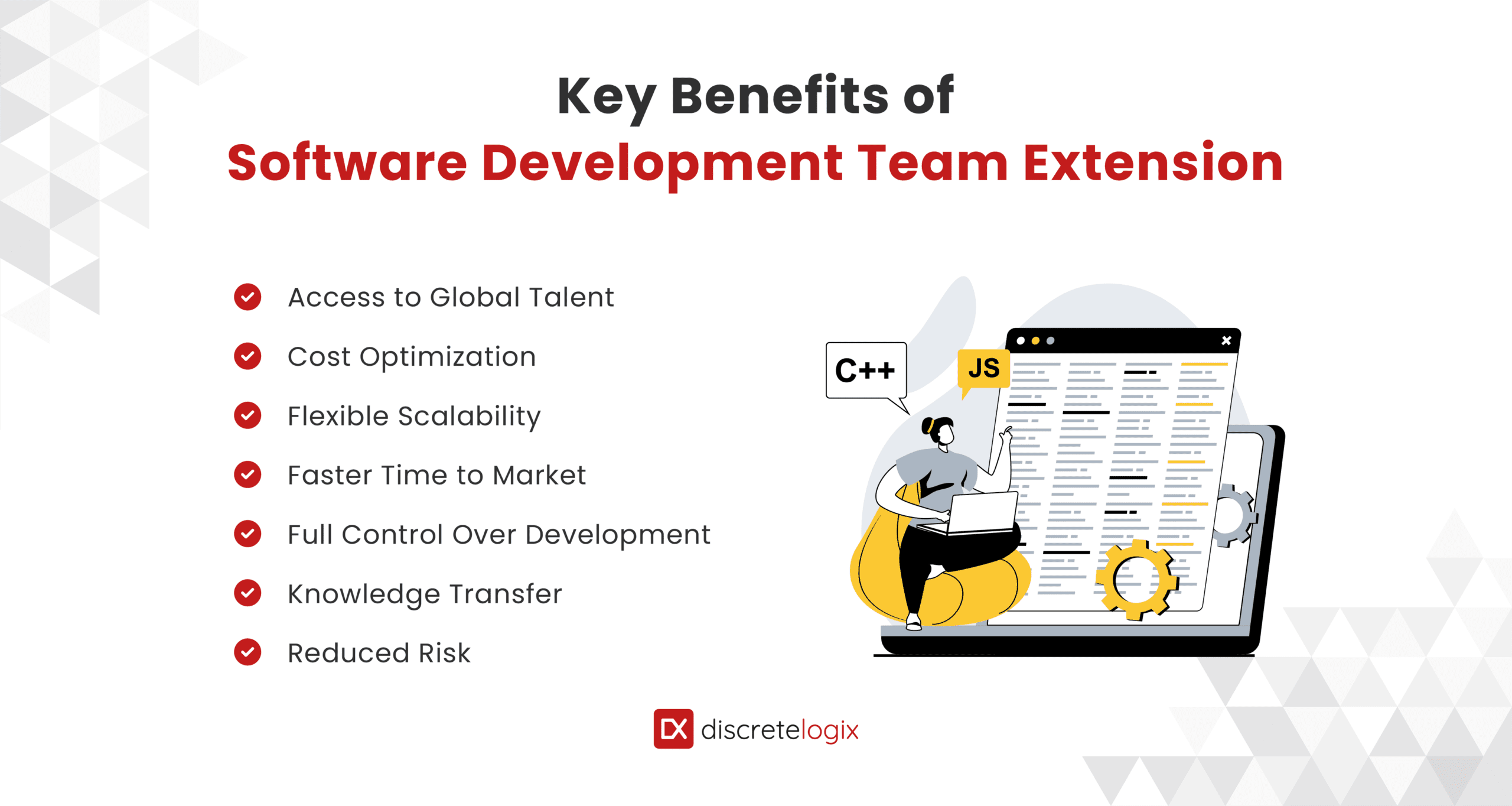
Rapid Access to Specialized Talent
Finding experienced software developers has become difficult, especially when specific skills are required. With team extensions, companies can access a global pool of developers instead of relying only on local hiring. This makes it easier to bring in niche expertise such as AI and machine learning, blockchain, cloud security, DevOps, or framework-specific skills like React Native.
Senior-level talent is particularly hard to hire locally. In many cases, companies wait four to six months to fill these roles. Using a development team extension, the same expertise can often be onboarded within two to four weeks, allowing the development process to continue without long delays.
Cost Optimization
Hiring local software developers in developed regions often comes with high salaries and added overhead. Remote team services help reduce these costs by allowing companies to work with skilled developers in regions where rates are more manageable.
In addition to salary differences, companies avoid recruitment agency fees, office space costs, employee benefits, and ongoing HR administration. Flexible scaling also helps prevent overstaffing, ensuring development capacity matches actual project needs.
Flexible Scalability
Project demands change over time. Product launches, feature updates, and seasonal workloads often require temporary increases in team size. Team extensions allow companies to scale their software development team up or down without long-term commitments.
This flexibility is especially useful for businesses with fluctuating demand, such as e-commerce companies that scale development capacity before peak seasons and reduce it afterward without disrupting the core team.
Faster Time to Market
Long hiring cycles slow down delivery. By reducing the time needed to add experienced developers, companies move faster from planning to release. Extended software development team members are already familiar with modern tools and workflows, which shortens ramp-up time.
This allows multiple workstreams to run in parallel, improving overall software development capacity and helping businesses respond faster to market changes.
Maintain Full Control Over Development
Unlike full outsourcing, this model keeps control within the internal team. Product owners and technical leads continue to manage priorities, timelines, and quality standards.
External team members follow existing tools, workflows, and methodologies. They participate in daily standups, sprint planning, and reviews, which keeps alignment strong and communication clear.
Knowledge Transfer and Retention
Short-term contractors often leave with valuable product knowledge. With a software development team extension, collaboration is usually long-term, allowing knowledge to remain within the organization.
Over time, the extended team members becomes familiar with the product, architecture, and business logic. Documentation improves, best practices are shared, and team dynamics become stronger.
Reduced Risk
Growing companies cannot afford instability. Team extension services reduce risk by avoiding long-term employment commitments while still providing consistent delivery. Many providers offer trial periods and replacement options if expectations are not met.
Geographic distribution also lowers dependency on a single hiring market, helping maintain stable software development capacity during local disruptions.
Challenges of Team Extension and How to Overcome Them
Communication Gaps
When teams work from different locations, delays and misunderstandings can happen. Time zone differences may slow responses, and written communication alone can sometimes miss context. If not handled early, this can affect daily coordination and decision-making.
Solution: Maintain a fixed daily working overlap, use asynchronous updates for routine work, and schedule weekly video calls to align on complex topics.
Cultural Misalignment
Different work cultures can lead to mismatched expectations around ownership, deadlines, or communication style. These differences may create friction if teams are not aligned on how work gets done.
Solution: Clearly share company values, working norms, and expectations at the start. Including the team in all-hands meetings and informal interactions helps build alignment faster.
Knowledge Transfer Delays
New team members need time to understand the product, codebase, and business logic. Without proper onboarding, productivity can drop during the early phase.
Solution: Maintain clear onboarding documentation, record key walkthroughs, encourage early pair programming, and assign a mentor to guide new members.
Security and IP Risks
Giving access to code and systems increases security risks if controls are weak. This is especially important when handling sensitive data or proprietary logic.
Solution: Use NDAs and IP agreements, apply role-based access, work in secure environments, and enforce strict code review practices.
Quality Inconsistency
As teams grow, differences in coding style or standards can affect maintainability and long-term stability.
Solution: Define clear coding standards and ensure they are followed through peer reviews and automated quality checks.
Increased Management Effort
Managing a larger or distributed team can require extra coordination, especially in the early stages.
Solution: Use project management tools, standard reporting formats, and manage everyone using the same processes to keep oversight simple.
How to Hire a Reliable Team Extension Partner
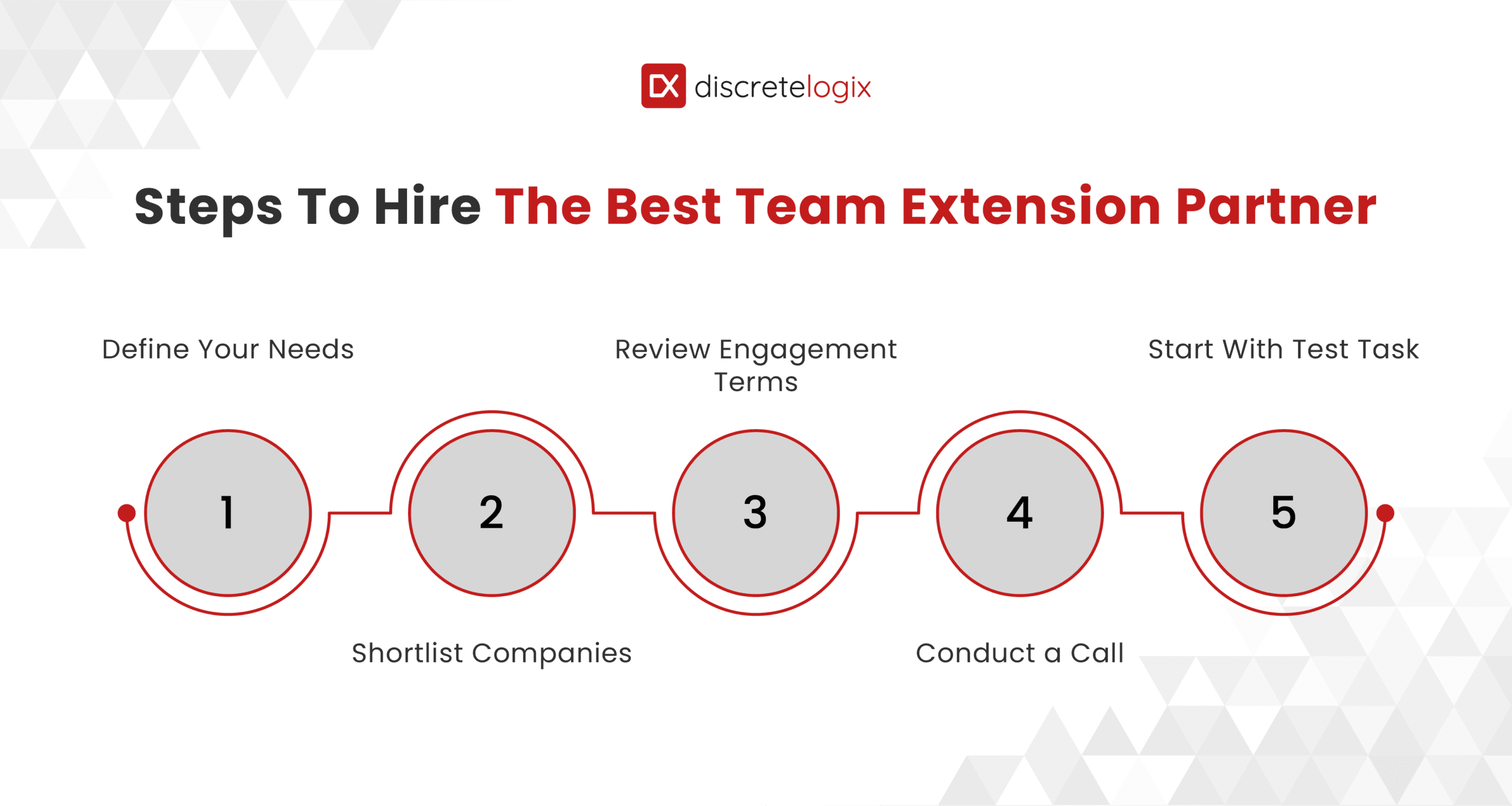
Step 1: Clearly Define Your Needs
Start by understanding what you actually need from the extended team. This includes the type of product you are building, the required tech stack, and the level of experience you expect. Decide whether you need developers who can work independently from day one or if some guidance will be available from your internal team. Clear requirements help avoid mismatches later.
Step 2: Shortlist Companies That Match Your Requirements
Once your needs are clear, look for companies that specialize in team extension and have experience in your domain. Use trusted platforms, referrals, and industry directories to compare options. Pay close attention to client reviews, case studies, and long-term partnerships rather than marketing claims.
Step 3: Review Engagement and Cooperation Terms
Not every partner will fit your expectations. Review pricing models, communication style, time zone overlap, and flexibility. Make sure the company follows proper privacy practices and is willing to sign NDAs and IP agreements. This step helps filter out providers that do not align with your working style or security needs.
Step 4: Conduct an Introductory Call
Before moving forward, schedule a video call with the potential partner and, if possible, the developers who may join your team. Discuss your project, timelines, and expectations in detail. This conversation helps assess communication skills, cultural fit, and how comfortable collaboration will be in the long run.
Step 5: Start With a Trial or Test Task
To reduce risk, begin with a small paid trial or test task. This allows you to evaluate real performance instead of relying only on resumes or interviews. A short trial often reveals how well the developer understands requirements, writes code, and communicates with the team.
The Cost of Team Extension Services
Before extending your team, it’s important to set a clear budget. The cost of a team extension mainly depends on where the developers are based, their level of experience, and the technologies you need. These factors decide how much you will spend and how easily you can scale your development team over time.
High-Cost Markets
Developers in North America and Western Europe are usually the most expensive. In the United States, software engineers often earn between $80,000 and $130,000 per year, depending on experience and specialization. Salaries in Western Europe are also high, with many developers earning $60,000 to $100,000 annually. Because of these high rates, companies in these regions often find it harder to scale their teams quickly.
More Affordable Regions
Some regions offer lower salary ranges, which makes them appealing for companies that want to control costs. In Eastern Europe, for example, many mid-level developers earn around $40,000 to $60,000 per year. This makes the region a good balance between cost, skills, and communication, especially for long-term collaboration.
Other regions such as Asia-Pacific and Latin America can be even more affordable. However, companies should be ready to manage time zone differences and communication styles when working with teams from these areas.
Looking Beyond Salaries
Salary is not the only cost to consider. With a development team extension, you usually avoid recruitment fees, employee benefits, office space, and long-term HR costs. These expenses can add 25 to 40 percent to the cost of hiring locally. A good partner includes these in their service, which makes costs easier to manage. In the long run, steady delivery, smooth communication, and lower management effort often matter more than choosing the cheapest option.
Discretelogix as a Team Extension Partner
We help businesses extend their development teams without the delays and risks of traditional hiring. Our team extension approach is designed to add skilled developers who can join ongoing projects quickly, work within your existing processes, and contribute from day one. This allows our clients to scale development while keeping full control over their product, codebase, and timelines.
Our teams are built around real project needs. Whether you are looking to hire mobile app developers or hire dedicated software developers, we focus on matching the right skills, experience level, and working style to your goals. Developers integrate smoothly with your internal team and follow your tools, workflows, and communication practices.
We work closely with our clients to understand their product vision, technical requirements, and growth plans. By operating as a true extension of your team, we support long-term collaboration, consistent delivery, and scalable development without increasing permanent overhead.
Frequently Asked Questions
Can I manage the extended team directly?
Yes, you can manage the extended team directly. You assign tasks, set priorities, run meetings, and control timelines just like you would with your in-house team. The team extension partner handles recruitment, contracts, payroll, and HR support, while you retain full authority over daily work and technical decisions.
How Does Your Business Benefit From Team Extension?
Team extension helps your business scale development quickly without long hiring cycles. You gain access to skilled developers, reduce recruitment and overhead costs, and maintain full control over delivery. It also allows flexible team sizing, faster releases, and long-term collaboration without committing to permanent hires.
How Much is the Cost of Software Development Team Extension Services?
The cost depends on developer location, experience level, and required skills. Pricing is usually hourly or monthly and is often more cost-effective than local hiring. Businesses also save on recruitment fees, benefits, office space, and HR costs, making overall spending more predictable.
How does outsourcing team extension improve project efficiency?
Team extension improves efficiency by quickly adding experienced developers to your existing team. This reduces hiring delays, enables parallel development, and keeps internal teams focused on delivery. Since developers integrate into your workflow, communication is faster and fewer handoffs are required.
How does team extension differ from outsourcing?
Team extension keeps developers fully integrated into your internal team and under your management. Outsourcing transfers responsibility for delivery to an external vendor. With team extension, you control priorities, processes, and quality, while outsourcing is usually more hands-off and project-based.
How is team extension different from outsourcing or staff augmentation?
Team extension focuses on long-term collaboration and integration with your team. Outsourcing is typically fixed-scope and vendor-managed, while staff augmentation is short-term and task-based. Team extension offers more stability than staff augmentation and more control than traditional outsourcing.
How to Find a Reliable Team Extension Partner?
A reliable partner should offer transparent hiring processes, strong technical screening, clear communication practices, and security standards. Look for flexibility in scaling, the ability to interview developers, and proven experience with similar projects. Client reviews and long-term partnerships are also strong indicators.
Is team extension suitable for short-term and long-term projects?
Yes, team extension works for both. It can support short-term capacity needs during peak workloads and long-term projects requiring continuous development. The model’s flexibility allows you to scale the team up or down based on project duration and changing requirements.
What is the difference between extended team and dedicated team?
An extended team works directly under your management and follows your internal processes. A dedicated team often comes with shared or vendor-led management. Extended teams are ideal when you want full control, while dedicated teams suit companies seeking more delivery ownership from the vendor.
When to Choose Software Team Extension Over Other Models?
Choose outsourcing IT team extension when you need fast scaling, long-term collaboration, and direct control over development services. It works best if you already have technical leadership in place and want flexibility without the delays and commitments of permanent hiring or full outsourcing.


